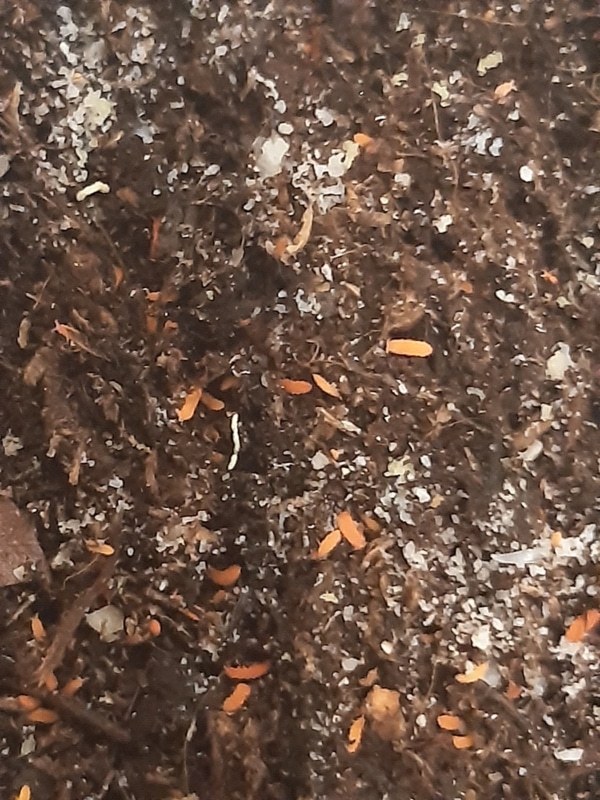
For anyone who wants to bring some color to their cleaning team, Bilobella braunerae is perfect. The reddish springtails are not a color mutation, but occur in nature. Very striking, you might think, but this species was only discovered and classified in 1981.
Our breeding animals are originally from southern Spain and therefore do not need a diapause. A diapause is a lowering of the temperature in winter. Bilobella braunerae is also found in Central Europe and therefore does not place high demands on the temperature.
There, too, they usually live hidden in dead wood under tree bark. In the terrarium they live relatively fearlessly and you get to see them more often. They are similar to the already known tropical white springtails. Differences can be found in size and also in their behavior. Bilobella braunerae, for example, does not jump! They don’t have a jumping fork, which makes them much more predictable in handling.
Of course, the claim of the relatively small springtails on a large terrarium is not given. Theoretically, you can already grow them in a house craft, which would be a shame, because this species comes into its own much better in a beautiful forest terrarium. For this purpose, all possible species can be socialized with Bilobella braunerae. Whether it’s centipedes, woodlice, snails, scorpions, spiders and anything else that lives in forests, appreciate the guidance of a first breaker that removes the remains.
The substrate should consist of forest humus, white rotten wood and foliage. Alternatively, flake soil and foliage can also be used. The substrate should always be kept moist and not dry out. We also feed a small pinch of springtail food every two days. As a result, the reproduction rate increases and the animals develop faster. Of course, you can feed vegetables and fruits.







Reviews
There are no reviews yet.